
 / willowfoam74's Library/ Notes/ Why Nordic Seahunter is considered the ideal small craft for oil spill response
Why Nordic Seahunter is considered the ideal small craft for oil spill response
from web site
When oil spreads across the water’s surface, you only get one shot at responding quickly. You need to move quickly with containment, get skimmers exactly where they should be, reach the shore without risk, and stand on a platform that doesn’t compromise your work. That’s the stage where the suitability of your oil spill cleanup vessel heavily influences the result.
Nordic Seahunter is a compact, multipurpose workboat that has quietly become a favorite among teams handling shoreline cleanup, harbor pollution, and small to mid-scale oil spill cleanup missions. It isn’t a large-scale response ship – and that’s a key part of its appeal.
In Oil Spill Cleanup with the Nordic Seahunter Vessel that follow, we’ll explore what truly counts in oil spill response and how Nordic Seahunter’s design, construction, and layout make it stand out as a small cleanup vessel.
Key Priorities in Modern Oil Spill Cleanup
Current oil spill cleanup practices go well beyond the basic act of setting out containment booms. Most successful cleanup efforts follow a predictable order of steps:
Rapidly establishing containment lines with well-placed booms
Skimming and free-product recovery
Careful deployment of sorbents where access is limited
Safeguarding and cleaning contaminated shore areas
Continuous tracking of conditions with proper documentation
At the core of every one of these steps is a reliable workboat. An effective oil spill cleanup boat needs to be able to:
Maintain a steady platform when towing long booms through waves and chop
Support skimmers, hoses, and vacuum lines without turning into a trip hazard
Approach rocky shores and shallow waters that are off-limits to bigger vessels
Shuttle people, tools, and absorbent products efficiently across multiple work sites
The vessel’s entire design in the Nordic Seahunter centers on executing missions of this nature.
Meet the Nordic Seahunter – a compact workhorse built for oil spill response
The Nordic Seahunter is a modern multi-role workboat intended for demanding coastal missions and operations in complex archipelago areas. It is especially effective when used for shoreline cleanup activities, collecting plastic and debris, handling emergencies, and managing oil spills.
From day one, the vessel was conceived as a durable working platform instead of a pleasure boat:
The boat is strikingly stable and configured to support heavy loads and rough day-to-day operations.
The boat can be deployed in coastal areas, port basins, rivers, and lakes – places where minor and medium spills often create significant damage.
Several Nordic Seahunter units can be joined together to create a wide or extended platform, expanding the available work area when operations scale up.
Put simply, it’s a small boat that offers big flexibility – exactly the kind of asset you want when designing a flexible spill response plan.
Key built-in features that position it as a strong and reliable oil spill cleanup vessel
1. Catamaran Stability and High Payload
Nordic Seahunter is built on a twin-hull (catamaran) configuration. Consequently, it achieves increased lateral stability compared with numerous small single-hull vessels, especially when operations are focused on one side with cleanup equipment.
The twin hulls are constructed to bear heavy loads, giving the vessel outstanding capacity relative to its compact footprint.
For oil spill cleanup, this stability is not just “nice to have” – it’s operational:
Moving long boom lines behind the vessel becomes less stressful and safer for the crew.
The crew can safely work on a single side rail without the boat reacting unpredictably.
Items such as portable winches, skimming gear, and bags full of sorbents can be kept on deck without destabilizing the vessel.
2. Tough, easy-care hull made from polyethylene
The vessel’s hulls consist of rotationally molded polyethylene, picked due to:
High impact strength
High resistance to UV exposure
An aptitude for handling seasonal temperature swings, from low winter readings to hot summers, without major degradation
For cleanup crews, this translates to:
Reduced likelihood of costly hull or gelcoat repairs after working near rocks and harbor walls
A vessel that takes tough daily use in rough environments in stride
A very low early-life maintenance burden, which lets operators invest more in cleanup equipment
When a hull eventually ages out of service, it can be processed and recycled, reinforcing a more sustainable lifecycle – a noteworthy advantage for environmentally responsible operators.
3. Slip-resistant deck combined with a purposeful work-platform layout
Nordic Seahunter features deck and walkway surfaces covered in anti-slip material, vital for safe footing around oily gear, wet ropes, and hoses.
The layout is intentionally open and clean:
A place to position boom reels or arranged boom sections
Clear zones where skimmers, portable pumps, and hose runs can be arranged
Open, clutter-free routes that allow safe movement in heavy PPE
In essence, you get a small but fully effective working deck – a must-have for an oil spill cleanup vessel expected to carry substantial equipment.
4. Flexible, modular platform design with scalability
A particularly unique aspect of the Nordic Seahunter is the ability to connect multiple hulls both along their length and across their width.
In practice, that means you are free to:
Operate at first with one small, responsive boat focused on oil spill cleanup
Use several linked Nordic Seahunters to provide a significantly larger floating work platform
Customise the platform layout for each mission without replacing the core boat fleet
For agencies or operators handling varied tasks – from minor port spills to long-running shoreline operations – this modular approach helps keep capital costs under control while still delivering real scalability.
How Nordic Seahunter supports all main phases of oil spill response
The Nordic Seahunter is not designed to cover every role of a large response ship, yet it consistently punches above its weight in day-to-day cleanup activities. Here’s how it aligns with the main phases of oil spill cleanup.
Containment and boom handling
Early containment is critical. Booms behave like flexible fence lines, trapping product and steering it in the direction of skimmers or safeguarded areas.
Here is how Nordic Seahunter fits into this part of the operation:
Tow and set foam-filled or inflatable booms in place from a solid, stable vessel platform
Use deck fittings and winch points to tension and adjust boom lines
Work in near-shore and harbor conditions where accurate and controlled maneuvering of booms is critical
Its compact, stable design lets it get into tight corners and narrow tidal channels that bigger vessels cannot safely or efficiently use.
Skimmer deployment and recovery
Skimming is the workhorse method of oil recovery. Weir, brush, drum, and disc skimmers each excel under particular conditions of viscosity and debris load.
Nordic Seahunter contributes the following:
A secure staging area on deck for skimmers and the hoses they require
Hull-born stability that minimizes unwanted movement of skimmer arms and frames
Allocated zones for placing portable hydraulic power packs or portable pump sets
Across many crews, these advantages collectively make the Nordic Seahunter an ideal support platform in the most critical offshore and near-shore oil spill cleanup phase.
Sorbent Handling and Near-Shore Work
As a rule, sorbent pads, booms, and cloths act as the “final polish” stage when the bulk oil has already been taken out. They play a critical role around piers, at dock edges, and in confined coves.
This is where Nordic Seahunter excels as a platform for accessing the shoreline:
Crews can step off onto rocky shores, retrieve saturated sorbents, and swap them out efficiently.
The vessel can transport full bags back to a larger mother ship or directly to a quayside for weighing and safe disposal.
Its combination of shallow draft and rugged hull lets it work effectively in the difficult water–land interface, the very area where much of the genuine cleanup activity takes place.
Moving crews and managing logistics
Responding to oil spills is extremely logistics-intensive: people, specialist tools, generators, sample coolers, PPE, and much more.
All over the world, Nordic Seahunter is deployed for:
Shoreline debris removal and general beach cleanup
Removing debris and pollutants from harbors and supporting overall port maintenance
Specialized missions in oil-spill cleanup and related environmental response work
The experience it has gained as a utility and logistics craft directly reinforces its performance in oil spill operations. The same traits that make it a great harbor cleanup boat – payload, stability, and maneuverability – make it a solid oil spill cleanup vessel as well.
Proven performance in real-world oil spill operations
Nordic Seahunter exists well beyond design drawings and specification sheets. The vessel has been used in various practical cleanup situations, such as:
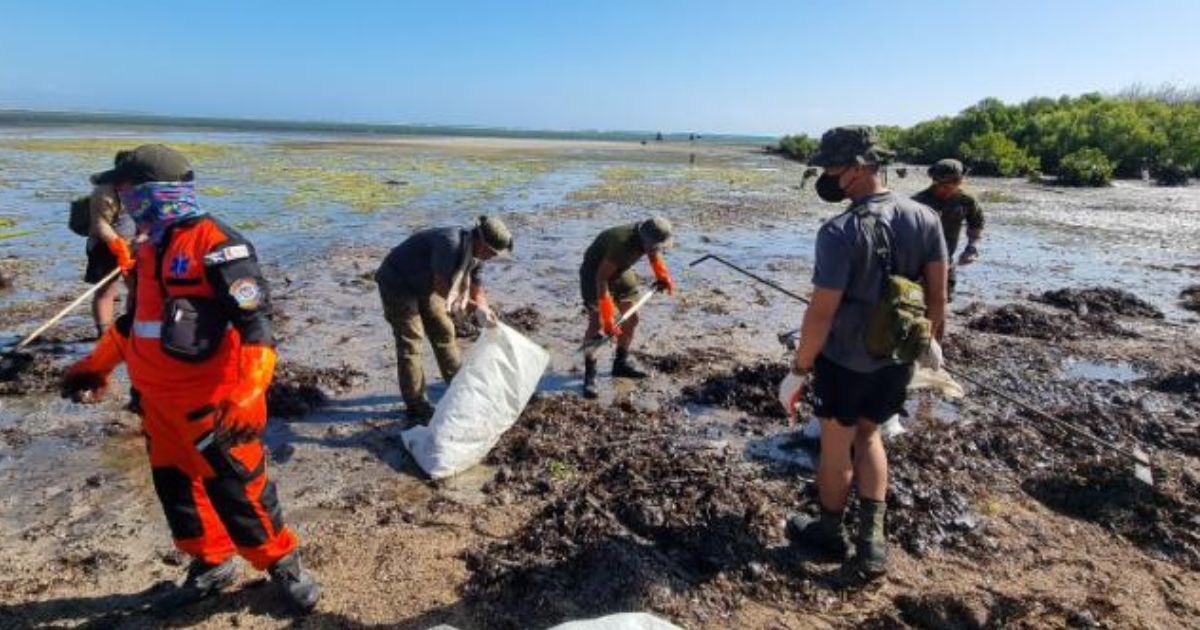
Cleaning the sides of larger coast guard and patrol vessels after oil spill operations – tasks that demand precise maneuvering alongside much bigger ships.
Working alongside Norwegian authorities to prepare dedicated rock-cleaning equipment in the aftermath of shoreline oil spills, emphasizing its capability in rugged coastal areas.
All of these references confirm that trained operators are using the boat in real, complex oil spill cleanup operations – not just in clean, controlled tests.
Adaptable configurations for different oil spill scenarios
Every operation presents a unique combination of factors. Each of these – a marina sheen, a river diesel spill, and a rocky-coast heavy fuel grounding – is a fundamentally different response challenge.
Nordic Seahunter’s design makes it straightforward to configure the boat for each mission:
It can be supplied with a broad selection of accessories and special solutions, all tailored to each operator’s needs – from deck equipment to lifting points and rail layouts.
Additional equipment packages can be added to make specific jobs easier and more efficient.
As a result, you can create a dedicated oil spill cleanup configuration – including boom handling gear, skimmer support systems, sorbent storage, and sampling equipment – yet still retain the ability to re-role the boat for other tasks later.
When Does Nordic Seahunter Make Sense as Your Oil Spill Cleanup Vessel?
You should take a close look at Nordic Seahunter if you:
Need a small but very stable vessel that can safely work near shorelines, among rocks, and in shallow areas
Want a vessel that can double as a harbor cleanup boat, SAR support unit, or transport craft when spill gear is not on board
Run spill response in regions where the logistics bill is significant, and stackable or easily transported boats can reduce that burden
Prefer a hull that is both durable and low-maintenance, and capable of taking serious punishment in the field
For municipalities, port authorities, fish farms, and industrial operators with environmental duties, Nordic Seahunter provides a practical way to add a capable oil spill cleanup vessel to the fleet without moving up to a full-size response ship.
FAQ: Oil Spill Cleanup and the Nordic Seahunter
Is the vessel Nordic Seahunter only intended for oil spill cleanup missions? No, that’s not the case. It serves as a multipurpose platform for tasks including shoreline cleanup, plastic retrieval, harbor maintenance, SAR backing, dive operations, freight hauling, and other work. Oil spill cleanup is simply one of the many roles it performs effectively.
What distinguishes it from standard rescue or patrol boats? Standard rescue and patrol boats are generally focused on speed and the rapid movement of personnel. Nordic Seahunter is shaped around being a work platform: serious payload capability, catamaran-style stability, non-slip deck surfaces, and the ability to interconnect multiple hulls into a larger work area – exactly what oil spill cleanup crews need.
Can one small oil spill cleanup vessel handle larger incidents? One boat alone can’t manage every dimension of a large spill, but Nordic Seahunter lends itself to effective scaling. You can scale up by operating several units in tandem, connecting them and partnering with bigger response ships and shore equipment to handle larger, more complex incidents.
Is the boat environmentally friendly from a design standpoint? Yes, in important ways. The polyethylene hull is long-lived and can be recycled at the end of its life, reducing waste and supporting more circular use of materials.
In closing
The right oil spill cleanup vessel is not defined by the largest engine or the most eye-catching brochure. It’s about rock-solid stability when the boom is under strain, non-slip footing on wet and oily surfaces, and a layout that remains workable over long, cold operations.
Nordic Seahunter brings together:
Stable twin-hull configuration supporting heavy payload requirements
A tough operational hull made with polyethylene that supports recycling
Flexible, modular platform options that can be scaled up
Established performance in harbor cleanup, shoreline tasks, and real oil spill operations
If you’re looking for a compact, honest workboat that makes everyday oil spill cleanup faster, safer, and more controlled, Nordic Seahunter is a very strong candidate to be the small vessel at the heart of your response plan.
Nordic Seahunter is a compact, multipurpose workboat that has quietly become a favorite among teams handling shoreline cleanup, harbor pollution, and small to mid-scale oil spill cleanup missions. It isn’t a large-scale response ship – and that’s a key part of its appeal.
In Oil Spill Cleanup with the Nordic Seahunter Vessel that follow, we’ll explore what truly counts in oil spill response and how Nordic Seahunter’s design, construction, and layout make it stand out as a small cleanup vessel.
Key Priorities in Modern Oil Spill Cleanup
Current oil spill cleanup practices go well beyond the basic act of setting out containment booms. Most successful cleanup efforts follow a predictable order of steps:
Rapidly establishing containment lines with well-placed booms
Skimming and free-product recovery
Careful deployment of sorbents where access is limited
Safeguarding and cleaning contaminated shore areas
Continuous tracking of conditions with proper documentation
At the core of every one of these steps is a reliable workboat. An effective oil spill cleanup boat needs to be able to:
Maintain a steady platform when towing long booms through waves and chop
Support skimmers, hoses, and vacuum lines without turning into a trip hazard
Approach rocky shores and shallow waters that are off-limits to bigger vessels
Shuttle people, tools, and absorbent products efficiently across multiple work sites
The vessel’s entire design in the Nordic Seahunter centers on executing missions of this nature.
Meet the Nordic Seahunter – a compact workhorse built for oil spill response
The Nordic Seahunter is a modern multi-role workboat intended for demanding coastal missions and operations in complex archipelago areas. It is especially effective when used for shoreline cleanup activities, collecting plastic and debris, handling emergencies, and managing oil spills.
From day one, the vessel was conceived as a durable working platform instead of a pleasure boat:
The boat is strikingly stable and configured to support heavy loads and rough day-to-day operations.
The boat can be deployed in coastal areas, port basins, rivers, and lakes – places where minor and medium spills often create significant damage.
Several Nordic Seahunter units can be joined together to create a wide or extended platform, expanding the available work area when operations scale up.
Put simply, it’s a small boat that offers big flexibility – exactly the kind of asset you want when designing a flexible spill response plan.
Key built-in features that position it as a strong and reliable oil spill cleanup vessel
1. Catamaran Stability and High Payload
Nordic Seahunter is built on a twin-hull (catamaran) configuration. Consequently, it achieves increased lateral stability compared with numerous small single-hull vessels, especially when operations are focused on one side with cleanup equipment.
The twin hulls are constructed to bear heavy loads, giving the vessel outstanding capacity relative to its compact footprint.
For oil spill cleanup, this stability is not just “nice to have” – it’s operational:
Moving long boom lines behind the vessel becomes less stressful and safer for the crew.
The crew can safely work on a single side rail without the boat reacting unpredictably.
Items such as portable winches, skimming gear, and bags full of sorbents can be kept on deck without destabilizing the vessel.
2. Tough, easy-care hull made from polyethylene
The vessel’s hulls consist of rotationally molded polyethylene, picked due to:
High impact strength
High resistance to UV exposure
An aptitude for handling seasonal temperature swings, from low winter readings to hot summers, without major degradation
For cleanup crews, this translates to:
Reduced likelihood of costly hull or gelcoat repairs after working near rocks and harbor walls
A vessel that takes tough daily use in rough environments in stride
A very low early-life maintenance burden, which lets operators invest more in cleanup equipment
When a hull eventually ages out of service, it can be processed and recycled, reinforcing a more sustainable lifecycle – a noteworthy advantage for environmentally responsible operators.
3. Slip-resistant deck combined with a purposeful work-platform layout
Nordic Seahunter features deck and walkway surfaces covered in anti-slip material, vital for safe footing around oily gear, wet ropes, and hoses.
The layout is intentionally open and clean:
A place to position boom reels or arranged boom sections
Clear zones where skimmers, portable pumps, and hose runs can be arranged
Open, clutter-free routes that allow safe movement in heavy PPE
In essence, you get a small but fully effective working deck – a must-have for an oil spill cleanup vessel expected to carry substantial equipment.
4. Flexible, modular platform design with scalability
A particularly unique aspect of the Nordic Seahunter is the ability to connect multiple hulls both along their length and across their width.
In practice, that means you are free to:
Operate at first with one small, responsive boat focused on oil spill cleanup
Use several linked Nordic Seahunters to provide a significantly larger floating work platform
Customise the platform layout for each mission without replacing the core boat fleet
For agencies or operators handling varied tasks – from minor port spills to long-running shoreline operations – this modular approach helps keep capital costs under control while still delivering real scalability.
How Nordic Seahunter supports all main phases of oil spill response
The Nordic Seahunter is not designed to cover every role of a large response ship, yet it consistently punches above its weight in day-to-day cleanup activities. Here’s how it aligns with the main phases of oil spill cleanup.
Containment and boom handling
Early containment is critical. Booms behave like flexible fence lines, trapping product and steering it in the direction of skimmers or safeguarded areas.
Here is how Nordic Seahunter fits into this part of the operation:
Tow and set foam-filled or inflatable booms in place from a solid, stable vessel platform
Use deck fittings and winch points to tension and adjust boom lines
Work in near-shore and harbor conditions where accurate and controlled maneuvering of booms is critical
Its compact, stable design lets it get into tight corners and narrow tidal channels that bigger vessels cannot safely or efficiently use.
Skimmer deployment and recovery
Skimming is the workhorse method of oil recovery. Weir, brush, drum, and disc skimmers each excel under particular conditions of viscosity and debris load.
Nordic Seahunter contributes the following:
A secure staging area on deck for skimmers and the hoses they require
Hull-born stability that minimizes unwanted movement of skimmer arms and frames
Allocated zones for placing portable hydraulic power packs or portable pump sets
Across many crews, these advantages collectively make the Nordic Seahunter an ideal support platform in the most critical offshore and near-shore oil spill cleanup phase.
Sorbent Handling and Near-Shore Work
As a rule, sorbent pads, booms, and cloths act as the “final polish” stage when the bulk oil has already been taken out. They play a critical role around piers, at dock edges, and in confined coves.
This is where Nordic Seahunter excels as a platform for accessing the shoreline:
Crews can step off onto rocky shores, retrieve saturated sorbents, and swap them out efficiently.
The vessel can transport full bags back to a larger mother ship or directly to a quayside for weighing and safe disposal.
Its combination of shallow draft and rugged hull lets it work effectively in the difficult water–land interface, the very area where much of the genuine cleanup activity takes place.
Moving crews and managing logistics
Responding to oil spills is extremely logistics-intensive: people, specialist tools, generators, sample coolers, PPE, and much more.
All over the world, Nordic Seahunter is deployed for:
Shoreline debris removal and general beach cleanup
Removing debris and pollutants from harbors and supporting overall port maintenance
Specialized missions in oil-spill cleanup and related environmental response work
The experience it has gained as a utility and logistics craft directly reinforces its performance in oil spill operations. The same traits that make it a great harbor cleanup boat – payload, stability, and maneuverability – make it a solid oil spill cleanup vessel as well.
Proven performance in real-world oil spill operations
Nordic Seahunter exists well beyond design drawings and specification sheets. The vessel has been used in various practical cleanup situations, such as:
Cleaning the sides of larger coast guard and patrol vessels after oil spill operations – tasks that demand precise maneuvering alongside much bigger ships.
Working alongside Norwegian authorities to prepare dedicated rock-cleaning equipment in the aftermath of shoreline oil spills, emphasizing its capability in rugged coastal areas.
All of these references confirm that trained operators are using the boat in real, complex oil spill cleanup operations – not just in clean, controlled tests.
Adaptable configurations for different oil spill scenarios
Every operation presents a unique combination of factors. Each of these – a marina sheen, a river diesel spill, and a rocky-coast heavy fuel grounding – is a fundamentally different response challenge.
Nordic Seahunter’s design makes it straightforward to configure the boat for each mission:
It can be supplied with a broad selection of accessories and special solutions, all tailored to each operator’s needs – from deck equipment to lifting points and rail layouts.
Additional equipment packages can be added to make specific jobs easier and more efficient.
As a result, you can create a dedicated oil spill cleanup configuration – including boom handling gear, skimmer support systems, sorbent storage, and sampling equipment – yet still retain the ability to re-role the boat for other tasks later.
When Does Nordic Seahunter Make Sense as Your Oil Spill Cleanup Vessel?
You should take a close look at Nordic Seahunter if you:
Need a small but very stable vessel that can safely work near shorelines, among rocks, and in shallow areas
Want a vessel that can double as a harbor cleanup boat, SAR support unit, or transport craft when spill gear is not on board
Run spill response in regions where the logistics bill is significant, and stackable or easily transported boats can reduce that burden
Prefer a hull that is both durable and low-maintenance, and capable of taking serious punishment in the field
For municipalities, port authorities, fish farms, and industrial operators with environmental duties, Nordic Seahunter provides a practical way to add a capable oil spill cleanup vessel to the fleet without moving up to a full-size response ship.
FAQ: Oil Spill Cleanup and the Nordic Seahunter
Is the vessel Nordic Seahunter only intended for oil spill cleanup missions? No, that’s not the case. It serves as a multipurpose platform for tasks including shoreline cleanup, plastic retrieval, harbor maintenance, SAR backing, dive operations, freight hauling, and other work. Oil spill cleanup is simply one of the many roles it performs effectively.
What distinguishes it from standard rescue or patrol boats? Standard rescue and patrol boats are generally focused on speed and the rapid movement of personnel. Nordic Seahunter is shaped around being a work platform: serious payload capability, catamaran-style stability, non-slip deck surfaces, and the ability to interconnect multiple hulls into a larger work area – exactly what oil spill cleanup crews need.
Can one small oil spill cleanup vessel handle larger incidents? One boat alone can’t manage every dimension of a large spill, but Nordic Seahunter lends itself to effective scaling. You can scale up by operating several units in tandem, connecting them and partnering with bigger response ships and shore equipment to handle larger, more complex incidents.
Is the boat environmentally friendly from a design standpoint? Yes, in important ways. The polyethylene hull is long-lived and can be recycled at the end of its life, reducing waste and supporting more circular use of materials.
In closing
The right oil spill cleanup vessel is not defined by the largest engine or the most eye-catching brochure. It’s about rock-solid stability when the boom is under strain, non-slip footing on wet and oily surfaces, and a layout that remains workable over long, cold operations.
Nordic Seahunter brings together:
Stable twin-hull configuration supporting heavy payload requirements
A tough operational hull made with polyethylene that supports recycling
Flexible, modular platform options that can be scaled up
Established performance in harbor cleanup, shoreline tasks, and real oil spill operations
If you’re looking for a compact, honest workboat that makes everyday oil spill cleanup faster, safer, and more controlled, Nordic Seahunter is a very strong candidate to be the small vessel at the heart of your response plan.
